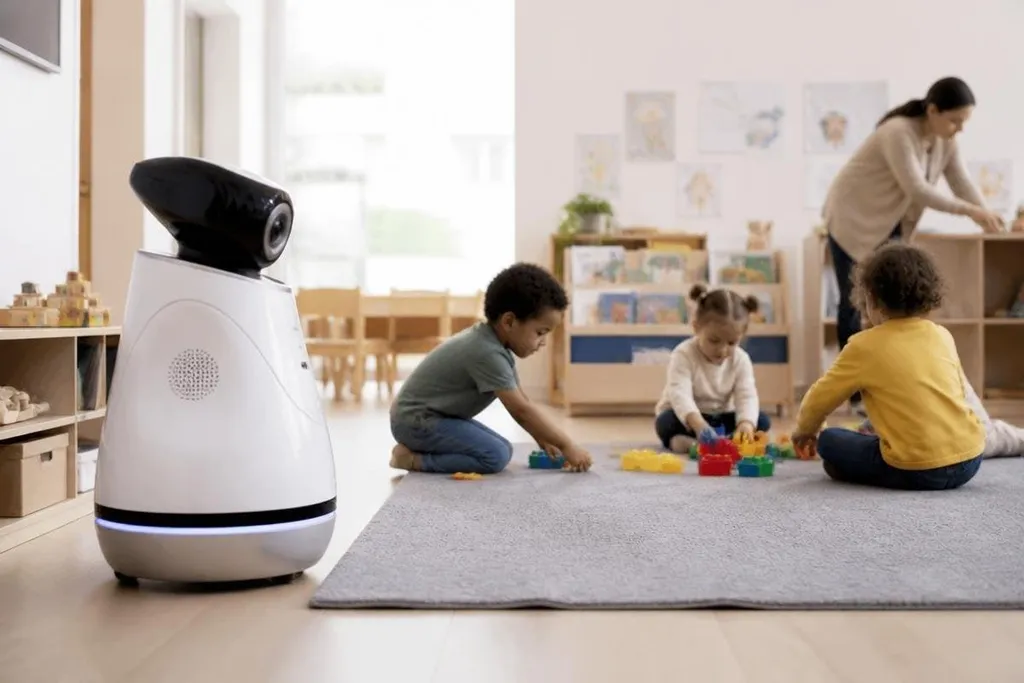
A childcare robot might read a story, spot a fallen child, or call an adult when a room becomes unsafe. Those tasks sound useful, but they raise hard questions about privacy, judgment, and who stays responsible when the robot misses something.
The practical question is where a robot should assist an adult and where it should stop.
Quick read
- Robots can handle repeated tasks such as stories, reminders, and room checks.
- Cameras and microphones create privacy risks for children, families, and staff.
- An adult must remain responsible for safety, comfort, and urgent decisions.
Where a childcare robot can help
The robot can repeat the same action without getting tired. That may suit reading practice, simple games, movement prompts, or reminders to wash hands.
A screen, speaker, and small mobile base can deliver these tasks in the same room while a caregiver handles other work.
The machine may also watch for clear events. A camera can detect that a child has fallen, moved into a blocked area, or left a marked zone. A microphone may pick up a loud alarm or a call for help. Each system needs a human check because a sensor sees patterns, not the full situation.
That limit matters during ordinary childcare. A child who is quiet may be asleep, frightened, ill, or concentrating. A robot can report the change. It can't decide what the child needs without help from an adult who knows the setting.
The safety risks
Movement creates the first set of hazards. A mobile robot can bump into a child, catch clothing, block an exit, or fall down steps if its sensors miss an edge. A safe design needs low speed, rounded surfaces, force limits, an easy stop control, and a clear route around children.
The robot also needs a safe failure mode. If its camera loses sight of a child, its network connection drops, or its battery runs low, it should alert staff and stop the task. A silent failure is harder to spot than a visible shutdown.
Software brings another problem. A system trained to spot falls or distress may work better in some rooms, lighting conditions, or body positions than others. Without test records for the actual childcare setting, a warning on the screen is only a prompt for human attention.
Privacy and trust
Childcare robots may collect video, audio, names, movement records, or speech. That information can reveal a child’s habits and a family’s daily routine, so the centre needs a clear reason for each sensor and a fixed deletion period.
Parents and staff should know when recording starts, where files go, who can see them, and how a family can ask for deletion. Children also need an age-appropriate explanation. A robot that listens all day changes the room even when nobody checks the recordings.
A childcare robot can collect audio while a child plays, so childcare robotics reporting from Robot24.com should show the sensor, storage rule, and adult who can stop it. That record leads to the next rule: a child may interact with the robot, but an adult remains responsible.
The adult stays in charge
The robot should give information to a caregiver, not make the final call about injury, discipline, medical care, or a child’s emotional state. That rule should appear in the operating plan, staff training, and purchase contract.
The strongest use case is narrow: the robot handles a repeatable task, records only what the task needs, and gives control back to a person when conditions change. I'd keep childcare robots in that role until independent testing shows how often they miss real hazards.
Before a centre buys one, check these points:
- Task limits: Write down the exact jobs the robot will do and the jobs staff will keep.
- Stop controls: Test the emergency stop from a child’s height and from the staff position.
- Data rules: Set recording times, file storage, access rights, and deletion dates.
- Failure alerts: Disconnect the network and block a sensor to see what staff are told.
- Room trials: Run supervised tests with the actual floor, furniture, noise, and lighting.
- Human cover: Keep an adult close enough to respond before the robot’s warning matters.
A childcare robot can repeat a story or flag a possible fall. The next buying decision should turn on one number: how quickly a named adult can reach the child after the alert.